

Plan with care. Design for life.
How to ensure a healthcare signage system endures.
Imagine walking through a hospital’s north entrance on a busy weekday morning. A temporary clinic has taken over part of a wing, hallways have been rerouted, and a new elevator bank just opened last month. Everything looks right except the directional signs: a few are slightly off in color, some are older, and one has been replaced with a laminated sheet taped to the wall. None of this happened overnight—it accumulated through every phase of change, every renovation, every rushed update.
This is the moment where system longevity quietly breaks down. More than a loss of visual inconsistency, it’s a subtle erosion of efficient wayfinding and trust in the brand at a time when patients and families are most vulnerable.
KEY CONTRIBUTOR:
Christopher Phillips
Director of Engineering
Healthcare environments intensify this problem in ways few other settings do. High-touch use, frequent disinfecting, ongoing renovations, shifting service lines, and unpredictable patient volume push signage harder than most settings. Without longevity built into the system from the beginning, mismatches, premature wear, and improvised fixes show up quickly and linger.
That’s why planning for signage system longevity is more than a design concern. In fact, it’s a matter of cost-control and experience management in environments where change is perpetual and patient expectations are high.
An enduring hospital signage system depends on three things working together: durable materials, repeatable fabrication, and clean pathways for updates. And the foundation for all three is established early—long before installation—when everything from substrates to system standards is planned with a changing environment in mind.

Select materials that withstand clinical realities
Consider one Midwestern health system where first-surface graphics in a pediatric wing began to cloud under aggressive disinfecting cycles. The haze didn’t appear suddenly, but over time it weakened legibility and gave the signage a prematurely worn look. The solution was a shift to more chemically resistant substrates and a protected graphic layer. This preserved clarity while withstanding thousands of cleaning cycles.
In the healthcare environment, surfaces endure constant sanitization, equipment abrasion, and near-continuous contact. Materials not selected with these realities in mind will age rapidly.
In that same Midwestern system, protective construction methods made a measurable difference: legibility stayed intact, surfaces remained clear, and the signs continued performing without fatigue. Thoughtful design and fabrication preserve credibility as much as function in the long term. Patients and visitors may not analyze signage, but they do recognize environments that feel clean, intentional, and cared for.

Maintain consistency as facilities grow and change
Hospitals rarely evolve all at once. They change wing by wing, floor by floor, sometimes room by room. Departments relocate temporarily and then permanently. New facilities open across a campus. Older spaces modernize in phases years apart.
Without a repeatable signage strategy, these changes introduce drift: a slightly different shade in one replacement, a revised mounting method from a different contractor, or a shortcut during a renovation that becomes permanent. Consistent fabrication methods, well-defined material standards, and clear guardrails protect long-term integrity and brand clarity.
Repeatability reduces variation, supports muti-campus alignment, and minimizes operational decision fatigue. It prevents every renovation from becoming a one-off interpretation.
At that same Midwestern health facility, repeatability proved essential as two wings were added over seven years. Because documentation captured exact color, substrate, and hardware standards, every update aligned with earlier work. No one had to interpret or improvise, and system integrity remained intact.
Across multisite hospital systems, the same principle applies. When facilities are able to reference Signage Design Standards, each location can execute updates consistently. This is true even amid differing budgets, room layouts, or phased renovations. Strong standards become one of the most straightforward safeguards against a fragmented patient experience.
Design signage updates as part of the system
A signage system designed for longevity treats updates as part of its architecture. Insert-based components, modular layouts, and clear distinctions between permanent and flexible signage types allow everyday changes without disrupting the system’s integrity. When updates can happen easily and predictably, no one is tempted to improvise with tape, temporary printouts, or off-standard replacements.
When updates are built into the system, facility teams save time, clinical leaders avoid confusion and brand integrity survives even rapid operational pivots.
Maintain shared standards to protect continuity
Even the strongest design intent weakens without documentation. Staff change, vendors rotate, and institutional knowledge shifts. If specifications are scattered across inboxes, memory, or past projects, consistency erodes.
Clear standards reduce rework, protect capital investments, and ensure that every update supports a cohesive patient and staff journey—no matter who executes it.
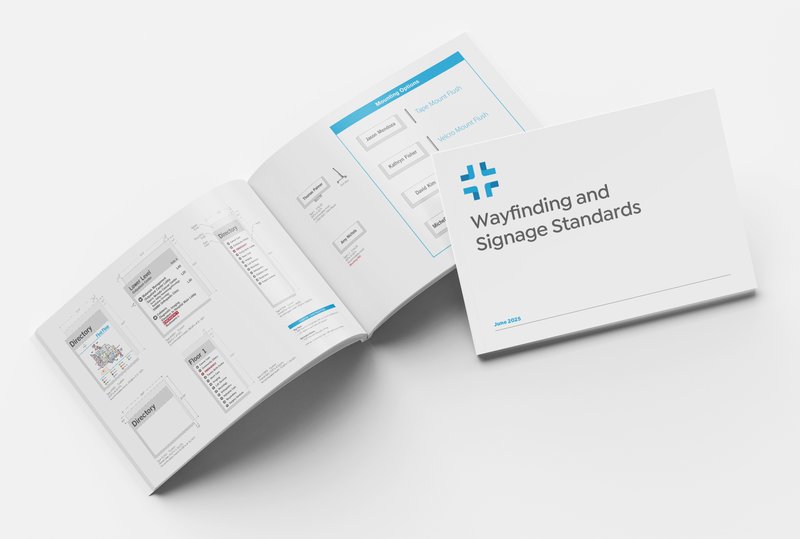
Design Standards Guidelines become the stabilizing reference: material specs, color standards, fabrication methods, mounting details, allowed variations, finish specifications, and ordering instructions. They ensure that five years from now—or fifteen—every update reinforces the system instead of diluting it.
Good documentation turns a signage project into a signage program.
Protect a calmer, clearer patient experience
Signage longevity protects the patient experience. When clarity remains intact through renovations and volume shifts, wayfinding feels effortless. When materials stay stable after constant sanitizing, the space feels cared for. When updates are seamless, no one hesitates.
Healthcare will keep evolving—sometimes predictably, often not. But environments that communicate clearly, age gracefully, and adapt easily bring stability to every stage of change. When signage is built as a long-term system rather than a one-time project, it becomes an asset your organization can rely on no matter how the future shifts.
Read more

ADA
ADA Compliance in Healthcare
24.8.2025

Design with a healthy dose of reality
25.10.2025

Simplify Complex Healthcare Projects for Clear, Confident Patient Experiences
28.9.2025
