

Lasting system, enduring brand
Protect your school’s consistent voice through years of change
You’re walking across campus in late October. Leaves are down. Air is cool. Homecoming weekend is on. The new science building looks exceptional – its signage clean, contemporary, and perfectly aligned with your updated brand standards. It reflects the institution you want the world to see.
But by the time you reach the historic quad, it happens.
A donor plaque is fading, a residence hall entry sign has weathered faster than expected, and a temporary paper printout is taped to a classroom door where department offices were recently relocated. Nothing is broken, but the cohesion is gone. And for alumni, prospective families, and donors walking the same path, these inconsistencies quietly shape how they experience the institution.
KEY CONTRIBUTOR:
Christopher Phillips
Director of Engineering
That’s how signage longevity issues reveal themselves in higher education—not through dramatic failures, but a gradual drift. A campus that once felt unified starts to feel choppy. A brand that once spoke with one voice now has hiccups.
For institutions competing on reputation, clarity, and a sense of place, this drift has real consequences. The good news: it's preventable. The solution is built on three principles. Durability that considers how students use spaces. Repeatability that maintains your brand across new and existing buildings. And updateability that allows everyday changes without improvisation or costly replacements.
Build durability around real student life
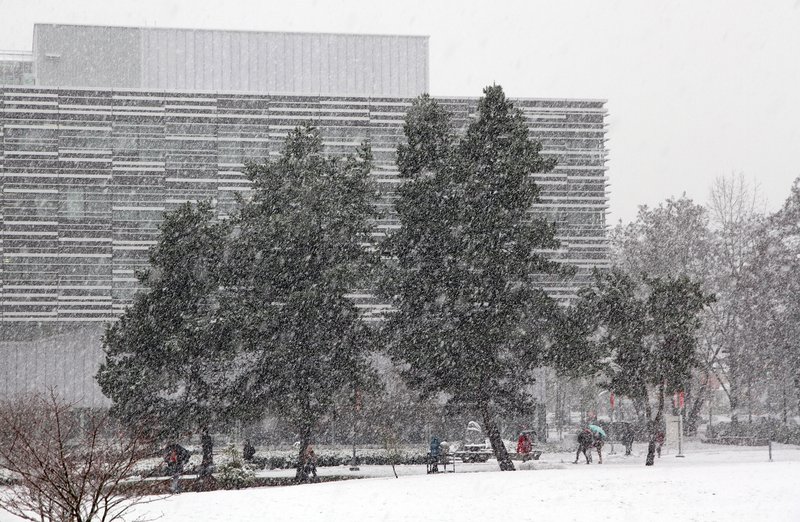
Student environments are demanding settings for physical signage. Classroom buildings are cleaned daily. Athletic centers face humidity, temperature changes, and heavy traffic. Outdoor signage weathers from sun exposure, rain, freeze-thaw cycles, and evolving footpaths.
When materials are selected solely for how they look on installation day rather than how they’ll age over years of campus life, issues surface early. Acrylics haze faster than expected. Graphics scratch or fade under regular cleaning. Exterior finishes don’t hold up equally across seasons.
Over time, these early failures add up—both visually and operationally. They create unplanned replacement cycles, emergency reorders, and incremental maintenance costs well beyond the original project budget.
At one large New England university, routine cleaning in student centers caused top-surface printed graphics to wear out faster than expected. A reevaluation led to protected graphic layers and a more abrasion-resistant substrate, which preserved clarity through multiple years of daily cleaning cycles and thousands of student interactions. Once durability aligned with real use, maintenance costs and visual inconsistencies dropped. Simply put, durability protects campus pride and operational efficiency.
Keep visual consistency as the campus evolves
Campus expansion rarely happens in a single chapter. Residence halls open in one planning cycle, a humanities building is renovated in another, and donor-funded athletic spaces appear in between. Each project presents a chance for inconsistency unless repeatability is built into the system. Without clear standards, each project team makes decisions in isolation—and those decisions quietly diverge over time.
Repeatability ensures that:
- Materials can be dependably sourced years later
- Colors stay true across multiple projects and throughout every location
- Fabrication, mounting methods, and hardware remain consistent and reliable
- Standards are interpreted consistently across project teams
At that same New England university, multiple academic wings were integrated over five years. Because color formulas, substrates, finishes, and hardware specifications were centralized in a Design Standards playbook, new signage blended seamlessly with existing environments. Alumni returning for campus events could walk building to building without sensing a break in identity.
Design updates as part of the system
Universities are defined by motion. Faculty change offices, programs reorganize, student services expand, and administrative units consolidate. Without updates built into the system, teams improvise—taped printouts, mismatched plates, cloned fonts, and one-off replacements that gradually dilute coherence and quietly erode confidence across the campus environment.
When updates are easy, continuity stays intact and improvisation disappears. A long-lasting system distinguishes between what must remain permanent and what requires flexibility. Durable exterior signs, code signage, and high-touch installations stay sealed and stable. But locations with natural turnover—faculty offices, student clubs, research labs—benefit from modular or insert-based components that allow clean, predictable updates.
Anchor consistency with a Design Standards playbook
Even the strongest design intent fades without memory. Facilities teams evolve, design partners rotate, and institutional knowledge shifts between departments. Without a shared reference, inconsistencies eventually appear.
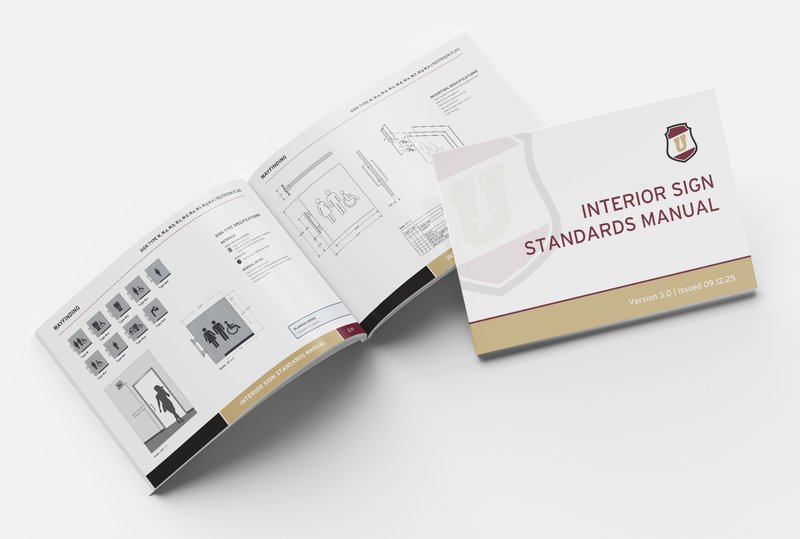
A Design Standards playbook functions as institutional infrastructure by supporting continuity across leadership changes and multi-year capital projects. It prevents drift by turning signage from a project into a sustainable program, documenting material specifications, mounting rules, color formulas, allowed variations, and sign families that work across mixed-era buildings. By streamlining reorders, it protects brand identity and keeps every future update aligned with the original strategy.
A more connected student experience over time
These days, no one knows exactly what a campus will look like six months from now—let alone six years. Programs change, buildings shift purpose, and enrollment needs evolve. But when durability, repeatability, and updateability are planned from the start, you never have to worry about your signage keeping up. It stays clear, cohesive, and instantly recognizable through every phase, every renovation, and every academic cycle. A campus that never sits still deserves signage that always feels grounded, connected, and confidently built for the journey ahead.
Read more

ADA
ADA Compliance in Higher Education
24.8.2025

How Signage and Experiential Graphics Bridge Legacy and Future on Campus.
20.7.2025

Wayfinding
On the Right Course: Creating Cohesion Across Campus
28.9.2025
