

At freestanding EDs, fast wayfinding is critical
As health systems expand Freestanding Emergency Departments (FSEDs), care is becoming more distributed, more immediate, and more vulnerable to operational decisions. That shift is happening at scale. According to the Emergency Medicine Network, the number of freestanding emergency departments nationwide grew from 50 in 2001 to 841 by 2022, and market analyses from Grand View Research project continued investment in the model through the end of the decade.
KEY CONTRIBUTOR:
Denielle Wilson
Project Manager
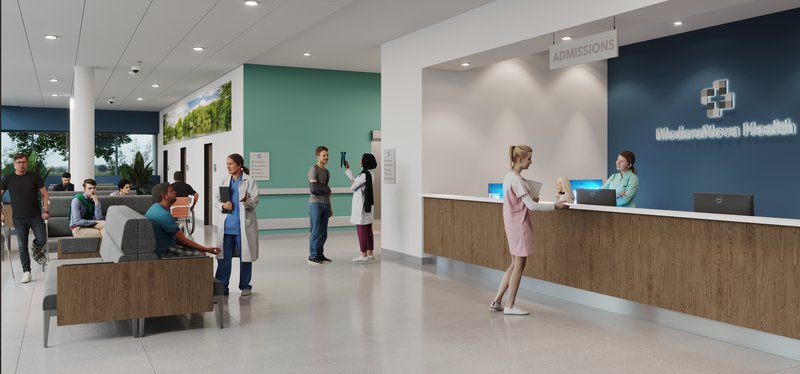
Unlike urgent care centers, FSEDs provide full emergency services in compact footprints with fewer buffers for confusion. Patients often arrive unfamiliar with the facility, and even brief hesitation affects throughput, staff capacity, and safety. In these environments, navigation must work instantly from parking to entry to check-in to treatment, without relying on staff intervention.
As FSEDs multiply, they reinforce a critical operational reality: clarity directly affects performance and patient outcomes. Which is why wayfinding is no longer a finishing layer applied late in the process. It functions as a core component of how emergency environments operate.
The urgency intensifies
FSEDs compress emergency care into smaller, high-performance environments designed for speed. With fewer buffers and less margin for error, users can’t count on familiarity that grows from repetition to find their way. Navigation must succeed immediately. It enables visitors act without stopping to interpret options. And fewer decisions mean a faster, calmer movement.
This dynamic was central during Takeform’s work supporting HonorHealth as the health system expanded its freestanding emergency care footprint in Arizona. From early planning conversations, the focus extended beyond sign placement to how people would move through the environment under pressure. Early collaboration allowed the team to resolve high-risk decision points before they became costly to correct during construction or operation.
Early planning helps manage risk
For health systems expanding freestanding emergency care, early wayfinding integration functions as a form of risk management. It reduces late-stage changes, limits operational workarounds, and helps new sites open with clarity built into the environment rather than corrected after the fact.
This perspective guided Takeform’s work with HonorHealth as the system expanded its freestanding emergency care footprint. Rather than waiting until floor plans were finalized, the team engaged early to identify decision points most likely to generate uncertainty. These included arrival from parking, the entry threshold, check-in, major intersections, and vertical circulation.
By addressing these moments at the conceptual level, confusion could be resolved before it affected patients, budgets, or schedules. Each decision point was designed to confirm a visitors’ progress and support their steady movement. It was all about reducing hesitation that can slow flow and complicate operations.
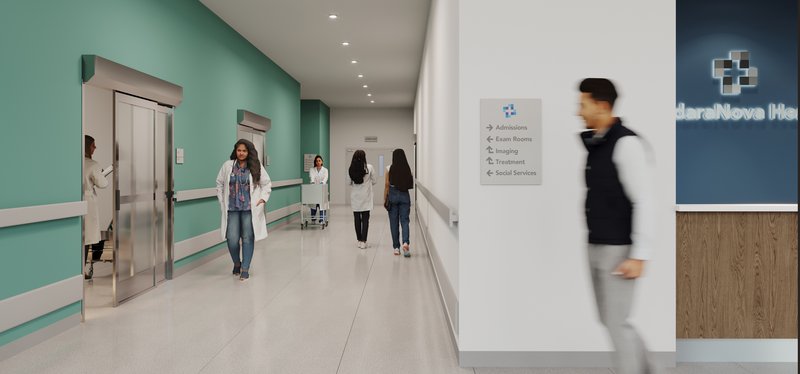
Fewer decisions keep care moving
Emergency environments demand rapid action with minimal interpretation. When patients and families are presented with dense lists of destinations or overly specific terminology, movement slows and uncertainty increases – often requiring staff intervention to keep care on track.
During Takeform’s work with HonorHealth, terminology strategy became a practical wayfinding tool. Destinations were grouped under concise, familiar umbrella terms such as “Imaging.” This reinforced language patients were already likely to recognize from scheduling and intake which reduces the need to list multiple individual services. This approach reduced reading time at key decision points and made choices easier and more intuitive.
Simplified language and disciplined hierarchy reduce variability, support faster decision-making, and allow people to move forward with confidence. Within a growing healthcare system, continuity accelerates progress and builds brand.
Architecture guides movement
Wayfinding does not operate independently of the building. In successful freestanding emergency environments, architecture itself becomes part of the navigational system – setting expectations, signaling direction, and reducing reliance on signage alone.
This consideration shaped decisions during the HonorHealth implementation. Lobbies, elevators, and major corridors were treated as orientation anchors rather than neutral space. Signage reinforced architectural cues so the environment itself supported intuitive movement.
When architecture and signage work together, people trust their movement. They rely less on sign density and more on spatial logic, which supports smoother flow and helps staff remain focused on care rather than redirection.
Consistency supports speed at scale
As health systems expand freestanding emergency care models, consistency becomes increasingly important. Predictable terminology and hierarchy improve staff familiarity, reduce operational friction, and support patient confidence across locations – especially as networks grow.
HonorHealth approached its freestanding emergency care expansion with a systemwide mindset. With multiple sites to manage, decisions had to be easy to scale without rework. To support that growth, Takeform aligned terminology, message hierarchy, and visual logic across locations, creating standards that could be applied reliably from site to site. This approach simplified updates and helped maintain brand continuity as the system evolved.
Lessons that extend beyond freestanding ERs
While freestanding emergency departments amplify these demands, the underlying principles apply across healthcare environments navigating constant change:
- Integrate wayfinding early with planning and operations
- Identify and reinforce true decision points
- Reduce cognitive load through simplified language and hierarchy
- Use architecture as a navigational asset
- Align wayfinding decisions with operational goals
- Apply system standards so clarity scales across multiple sites
Bottom line: Clarity is critical to care
As healthcare continues to move toward faster, more distributed models of care, environments must perform reliably under pressure. Freestanding emergency departments make that expectation visible. When patients arrive anxious and time-critical, clarity directly shapes how efficiently care is delivered.
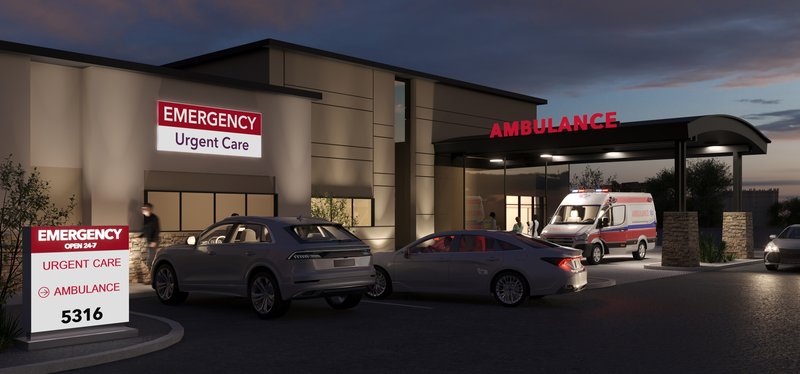
When wayfinding is planned early and aligned with operations, navigation becomes intuitive. Staff interruptions decrease. Hesitation fades. Patients and families can move forward with confidence, even in high-stress moments.
In emergency care models, clarity directly supports throughput, staff focus, and patient outcomes. It shapes how care is delivered when time and precision matter most.
Our Work in Healthcare

Baylor St. Luke's Medical Campus
As part of the new 12-story O’Quinn Medical Tower at Baylor St. Luke’s Medical Center – McNair Campus in Houston, Takeform delivered a comprehensive signage package to support cancer care and surgical services. Building on our long-standing partnership with CommonSpirit Health, we produced and installed over 4,700 pieces of signage across the tower and three parking garages.

Hoag Health Center Foothill Ranch
Hoag Health Center in Foothill Ranch partnered with Takeform to transform a 44,000-square-foot retail space into a welcoming, hospitality-inspired healthcare environment. By joining the project early, we helped shape a calming, community-focused space that delivers elevated care and an enhanced patient experience.

Cayuga Park Medical Office
A modern medical hub for New York’s Finger Lakes, Cayuga Park Medical Building needed signage as thoughtful as its care. Takeform delivered a cohesive system that guides visitors with ease while echoing the facility’s wave-inspired design, creating a welcoming, locally rooted healing environment.