

Design with a healthy dose of reality
Three early choices that keep your health facility’s signage hardworking.
You deal with a care environment that never slows down. And your signage has to keep pace with every shift, surge, and renovation that comes with it. Staff changes, department moves, heavy use, and constant cleaning all push a system hard. And long before a sign reaches a corridor or clinic, choices about components, materials, and fabrication have already determined how well it will hold up.
Those early decisions directly influence clarity, safety, infection-control performance, and operational efficiency. If the system is rooted in real clinical needs, it remains dependable. If not, it becomes a source of ongoing frustration – ineffectiveness, inconsistencies, repairs, and replacements.
KEY CONTRIBUTOR:
Christopher Phillips
Director of Engineering
Across healthcare facilities, three key considerations reliably determine whether a signage system will withstand the realities of care environments once clinical teams and patients begin relying on it.
1. Design for clarity when patients need it most
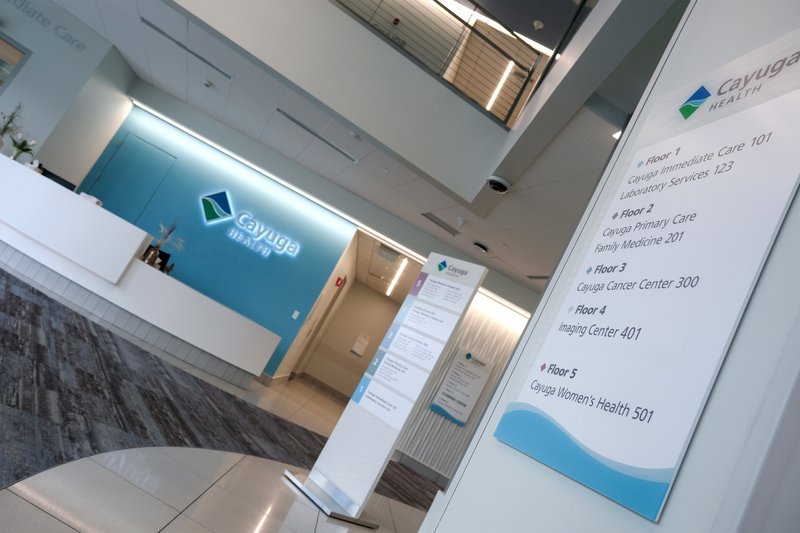
Creativity has a role in healthcare signage, but communication must be the first priority. Brand expression and aesthetic sensitivity must be balanced with clarity. Patients can be anxious, disoriented, or moving with urgency. Visitors may experience similar emotions when moving through an unfamiliar facility. Staff navigate spaces quickly, often while focused on demanding tasks and or other priorities. In these circumstances, overly stylized or aesthetically complex design can hinder more than it helps.
One major Midwestern health system with multiple facilities was looking to simplify the patient journey across its flagship hospital. Their redesign revealed how early creative decisions could either clarify movement or unintentionally create hesitation.
Effective design decisions for healthcare produce a sign system that delivers effortless legibility. Messaging, pictograms, and layout must hold up in every environment and situation – from bright light to dim corridors, in crowded waiting areas and high-stress moments. Design choices should eliminate confusion, reduce cognitive load, and support intuitive navigation.
When creativity enhances clarity rather than competing with it, the system becomes an invisible ally – steady, calming, and reliable whether the environment is routine or urgent.

2. Maintain consistency through every clinical transition
Few industries expand and change as frequently as healthcare. Sign systems must be designed to support continuity across every upgrade, expansion, and acquisition. Without careful advanced planning, these changes cause inconsistencies that negatively affect patient experience and brand continuity. Early choices determine whether the system will remain consistent through all these transitions. When continuity features are baked into the standards, the sign system supports change without losing coherence. That means making sure materials, colors, fabrication, and quality match project after project.
For that Midwestern health system, continuity became essential as new outpatient clinics were added and older wings underwent renovation. Each phase required signage that matched established standards exactly.
A consistent signage system makes it easier for patients to trust the environment, for staff to move efficiently, and for facilities teams to maintain continuity through every change.
3. Choose materials that withstand clinical cleaning
Cleanability in healthcare is non-negotiable. Daily sanitization cycles, strong disinfectants, and frequent touch quickly reveal which materials were chosen thoughtfully and which were not. Some substrates cloud or crack under repeated chemical exposure. Edges can lift, finishes can wear down, and insert lenses can scratch or dull.
In this same Midwestern system, cleanability requirements varied widely between inpatient units, specialty clinics, and high-traffic lobbies. Material selection needed to support strict infection-control protocols while staying durable under relentless cleaning cycles.
Early material and fabrication method decisions determine how the entire system holds up. Substrates must be chemically resistant; graphics must be protected from abrasion; lens materials must stay clear long after installation; and assembly methods and mounting systems must remain secure despite continuous stresses.
Cleanability not only affects infection control but also the perceived quality of the environment. Signs that wear prematurely impact brand image and undermine trust.
Ensure your system has what it takes
Healthcare facilities juggle endless complexity. Sign systems should not add to it. Supporting easy navigation, expressing brand, supporting healthy environments, and keeping pace with change should all be designed in. When early design and construction choices reflect real clinical demands, the system maintains clarity through transitions rather than becoming an issue that undermines patient experience and complicates operations.
A signage program grounded in the realities of care environments is both functional and supportive. It reassures patients, guides visitors, and helps staff stay focused on delivering care.
By planning for how the system will truly be used, touched, cleaned, and expanded, healthcare organizations create signage that performs reliably on day one and continues to withstand the pressures of clinical life for years to come.
See our work in healthcare

Baylor St. Luke's Medical Campus
As part of the new 12-story O’Quinn Medical Tower at Baylor St. Luke’s Medical Center – McNair Campus in Houston, Takeform delivered a comprehensive signage package to support cancer care and surgical services. Building on our long-standing partnership with CommonSpirit Health, we produced and installed over 4,700 pieces of signage across the tower and three parking garages.

Phoenix Children's Arrowhead Campus
To support its expanding presence in the West Valley, Phoenix Children’s opened the Arrowhead Campus to improve access to specialized pediatric care. In collaboration with Healthcare Graphics Consulting, Takeform delivered a cohesive signage system - spanning interior, exterior, and donor recognition - that enhances wayfinding, maintains brand integrity, and simplifies future growth.

Hoag Health Center Foothill Ranch
Hoag Health Center in Foothill Ranch partnered with Takeform to transform a 44,000-square-foot retail space into a welcoming, hospitality-inspired healthcare environment. By joining the project early, we helped shape a calming, community-focused space that delivers elevated care and an enhanced patient experience.
